Layers of the Earth study song
Quick answer
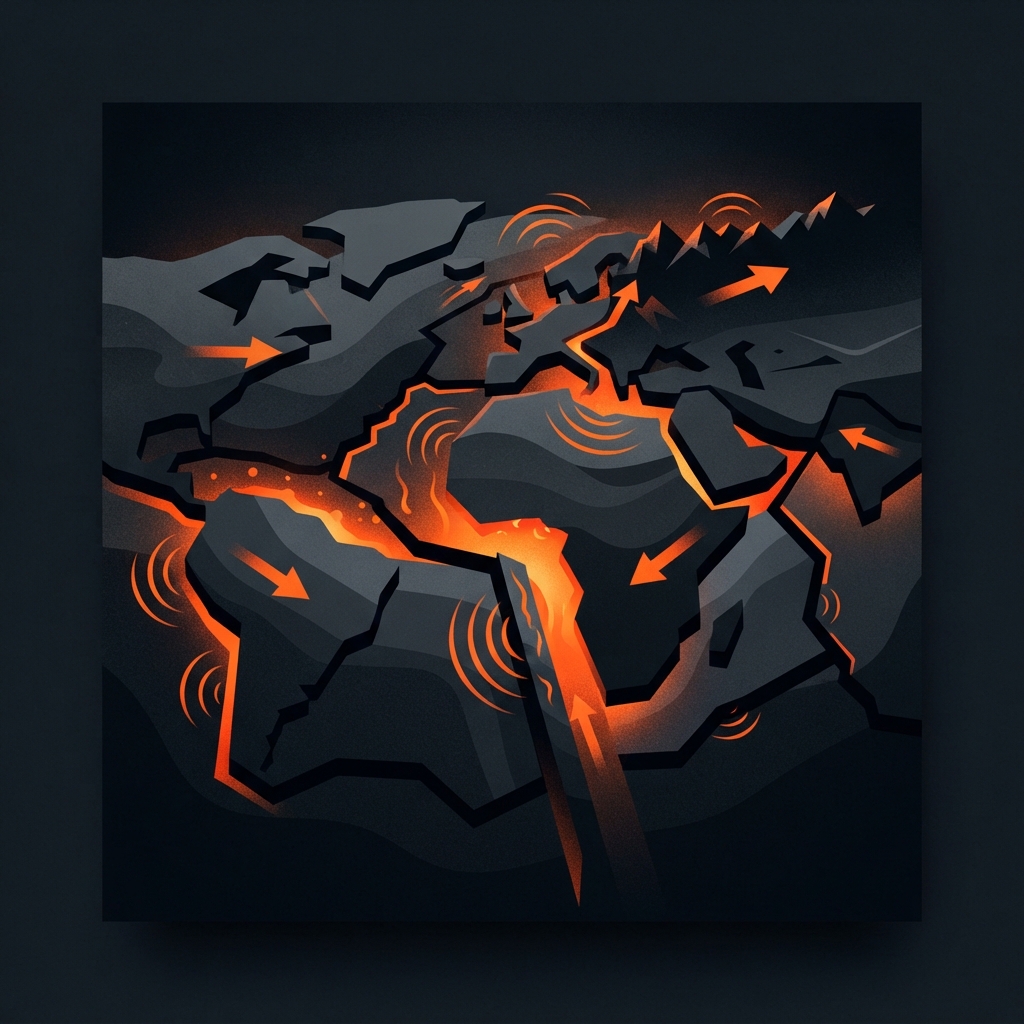
Earth is built like a layered sphere, and the order, thickness, state and temperature of each layer are standard exam material. From the surface down you meet the crust, the mantle, the liquid outer core and the solid inner core, and each has a different composition and behaviour.
Questions often ask why the inner core is solid despite being the hottest layer, or which layer generates the magnetic field. Students usually remember the names but lose the numbers and the solid-liquid pattern. A song works well here because the layers form a fixed list read from top to bottom, which fits a counting-down structure, and the rhythm helps lock the numbers to each layer.
5 facts to know about layers of the earth
- 1The crust is the thinnest layer, about 5 to 10 km under oceans and about 30 to 50 km under continents.
- 2The mantle is about 2,900 km thick and makes up roughly 84 percent of Earth's volume.
- 3The outer core is liquid iron and nickel, and its movement generates Earth's magnetic field.
- 4The inner core is solid because of immense pressure, despite temperatures of roughly 5,000 to 6,000 degrees Celsius.
- 5The Mohorovicic discontinuity (Moho) is the boundary between the crust and the mantle.